
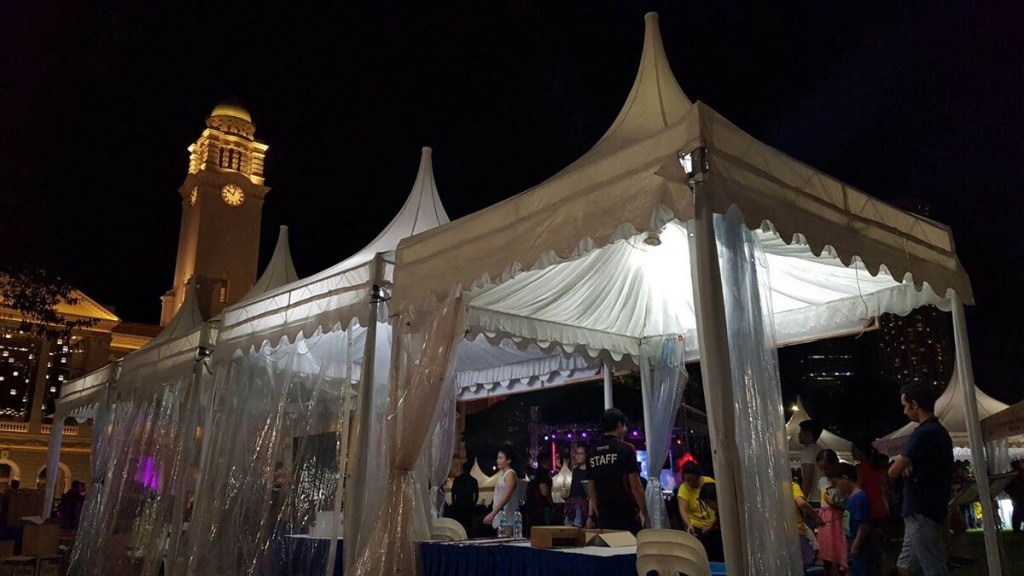
Tentage in Singapore traces back to kampong days, when simple canvas canopies sheltered wedding feasts and community gatherings between wooden houses. As Singapore urbanised into HDB estates through the 1960s-80s, tentage moved to void decks and became the default setup for weddings, wakes, and celebrations in a land-scarce city. Today it spans everything from a 20-pax void deck birthday to a 2,000-pax corporate gala.
How did tentage setups change as Singapore urbanised?
Before HDB estates, kampong weddings and funerals used simple canvas tents strung between houses or set up on open ground, often assembled by family and neighbours rather than professional crews. As land grew scarcer and housing moved vertical, void decks became the natural successor — a covered, accessible, shared space built into nearly every HDB block.
By the 1980s and 90s, tentage had shifted from a DIY community effort to a proper trade, with dedicated suppliers offering aluminium-framed structures, proper anchoring for concrete surfaces, and crews trained to work within tight void deck footprints.
Why did void decks become central to Singapore’s tentage culture?
- Universal availability. Nearly every HDB block has one, giving residents a free, covered, weatherproof space for events.
- Community norms. Void deck weddings, wakes, and D&Ds became an accepted, expected part of estate life across generations.
- Practical constraints. Small flats meant most families couldn’t host large gatherings at home, making the void deck the natural extension of the household for major life events.
- Town council structure. A clear booking and permit system developed around void deck use, formalising what had once been informal kampong arrangements.
How has tentage technology evolved over the decades?
| Era | Typical tentage |
|---|---|
| Kampong era (pre-1960s) | Simple canvas canopies, wooden poles, community-assembled |
| Early HDB era (1960s-80s) | Basic canopy tents adapted for void deck concrete surfaces |
| 1990s-2000s | Aluminium-framed tentage, standardised sizing, professional crews |
| 2010s-present | Aircon tentage, clear-span structures, transparent canopies, modular sizing for events from 20 to 2,000+ pax |
What hasn’t changed despite all the modernisation?
The core purpose has stayed constant: giving families and communities a covered, dignified space for life’s biggest moments, from weddings to wakes, in a country where private outdoor space is scarce. What’s changed is the engineering behind it — better anchoring for concrete, aircon options for Singapore’s heat, and crews who understand both the structural side and the cultural expectations around different event types.
The most common thing we hear from long-time residents is how void deck events feel like a shared tradition across generations — grandparents who had their wedding tentage there decades ago, now watching grandchildren celebrate the same way in the same space.
FAQ
When did professional tentage rental companies start operating in Singapore?
The trade professionalised gradually from the 1980s onward, as HDB estates expanded and demand for reliable, code-compliant setups grew beyond what informal community arrangements could provide.
Are void deck events still common today?
Yes, void decks remain one of the most frequently used spaces for tentage in Singapore, particularly for weddings, wakes, and community events within HDB estates.
How has aircon tentage changed outdoor events in Singapore?
It’s made longer daytime events more comfortable in Singapore’s heat, expanding what’s practical to host outdoors beyond just evening functions.
What role did tentage play in kampong communities?
It provided shared shelter for major life events — weddings, wakes, festivals — often assembled collectively by family and neighbours rather than hired professionally.
Is tentage still relevant as Singapore modernises further?
Very much so — land scarcity means outdoor, temporary structures remain essential for hosting large gatherings that indoor venues can’t accommodate as flexibly or affordably.
What stories do long-serving crews carry from this history?
Crew members who’ve been in the trade for 15+ years often talk about setting up tentage for the same families across two or three generations — a grandmother’s wedding, her daughter’s, now her granddaughter’s, all under a canopy in the same void deck. It’s a small but telling thread running through Singapore’s rapid urban change.
These crews have also watched the trade adapt to new expectations: better weatherproofing as monsoon patterns felt less predictable, aircon options as comfort expectations rose, and stricter safety standards as BCA and town council requirements matured over the decades.
Your next step
We’ve been part of this trade through decades of change. Read more about our story or browse examples of our work across all these event types.
