Checking a site for drainage issues before setup, not just on the event day itself, catches low points where water can pool during rain and lets the tentage crew plan flooring, positioning or minor drainage solutions in advance. This guide covers what to look for and how it’s addressed.
Identifying Drainage Risk Before Setup
Low-lying areas, spots where water visibly collects after previous rain, and surfaces that slope toward rather than away from the planned tent location are the main things to check during a site visit. Void decks with slightly uneven concrete flooring can develop pooling just as easily as open fields, so this isn’t purely a grass-and-soil issue.
A site visit during or shortly after rain gives a far more accurate picture of drainage behaviour than a dry-day assessment, which is worth requesting for significant events where drainage is a real concern.
How Tentage Crews Address Drainage
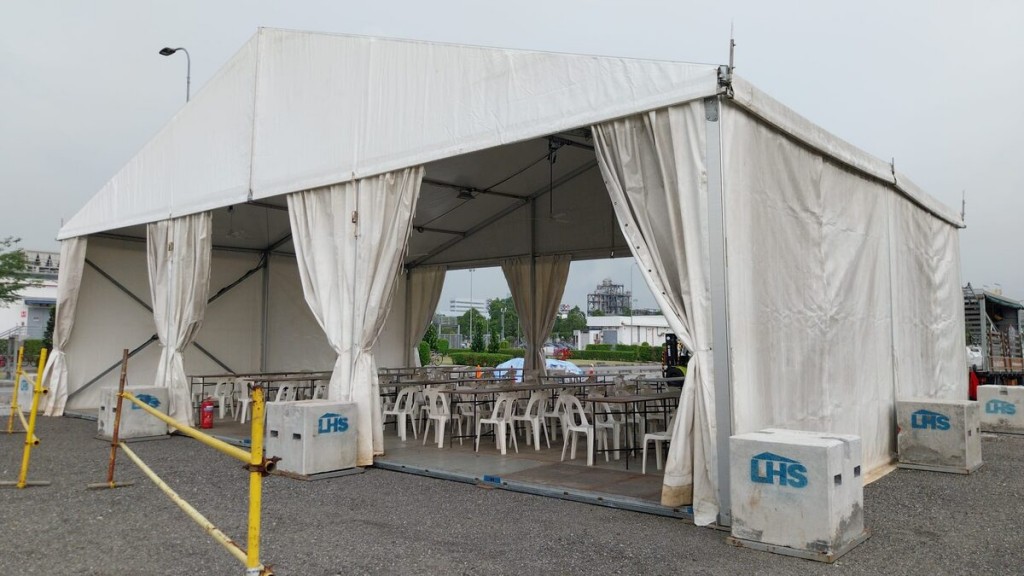
Positioning the tent slightly away from identified low points, adding temporary drainage channels where feasible, and using flooring to create a stable surface above minor pooling are the main practical responses. For genuinely problematic sites, relocating the event to a better-draining area of the same venue is sometimes the simplest solution.
Frequently Asked Questions
Can drainage issues be fixed on the day of the event?
Some minor issues can be managed reactively, but genuine drainage problems are best identified and addressed during planning rather than discovered on event day when options are more limited.
Do void decks have drainage issues too?
Yes, uneven concrete flooring at some void decks can develop pooling during heavy rain, so this isn’t just a concern for grass or open-field venues.
Is a site visit necessary for every event?
Not always necessary for smaller, straightforward setups, but genuinely worthwhile for larger events, venues with known drainage history, or any booking during the Nov-Jan monsoon season.
Temporary Drainage Solutions
Shallow trenching around the tent perimeter, directing water away from the seating area, is a common and relatively simple temporary drainage measure for sites with mild pooling issues. This doesn’t require permanent alteration to the site and can typically be reversed completely after the event.
For more significant issues, raised flooring that lifts the walking and seating surface above ground level entirely sidesteps pooling concerns, treating the drainage problem as something to elevate above rather than solve directly.
Signs a Site Might Have Drainage Problems
Visible erosion patterns, patches of unusually lush or different-coloured grass indicating consistent moisture, and standing water even a day or two after the last rain are all signs worth flagging during a site assessment. Neighbours or venue management familiar with the space can also be a good source of informal knowledge about how the site behaves during heavy rain.
Working with Void Deck and Field Bookings
For void deck bookings, checking with the town council or venue management about any known drainage issues at that specific location can surface useful history before committing to the booking. For open fields, particularly less-used venues, a physical site visit is more valuable than relying on assumptions, since these spaces vary significantly in drainage quality even within the same general area.
Who’s responsible for identifying drainage issues, the family or the tentage company?
It’s genuinely a shared responsibility. The tentage crew should flag visible risks during setup, but sharing any known history of the site, previous flooding, known low points, from the family or event organiser’s side speeds up an accurate assessment considerably.
The Cost of Getting This Wrong
The most common consequence we see when drainage isn’t addressed properly is a genuinely unpleasant guest experience, muddy shoes, damp seating, an unstable dance floor, that undermines an otherwise well-planned event. This is particularly frustrating because it’s almost always preventable with a bit of upfront attention rather than an unavoidable weather outcome.
Compared to the cost of flooring or basic drainage measures, the reputational and experiential cost of a flooded event space is far higher, which is why we treat this as a standard part of site assessment rather than an optional add-on conversation.
A quick conversation about the site’s history at the time of booking, rather than during setup itself, gives everyone involved enough lead time to plan properly rather than reacting to a problem discovered too late to fully address.
This is a simple step, but it’s one of the most effective ways to prevent an otherwise well-planned event from being undermined by something entirely fixable in advance.
Next Step
For a site assessment ahead of your event, reach out through our tentage rental services, or contact us directly to discuss your venue.
